Climate Change Adaptation
Permaculture & Climate Resilience
The Agenda for Change Foundation works with smallholder farming communities in Central Malawi, where roughly four-fifths of households depend on rain-fed agriculture. Led by women and rooted in local knowledge, the Climate Change Adaptation project supports farming households — over 60% of them women — in adopting climate-smart permaculture practices that restore degraded land, stabilise yields, and diversify nutrition and income.
Why It Matters
A changing climate, local solutions
Rainfall patterns across Central Malawi have become increasingly unpredictable. Erratic onset of the growing season and prolonged mid-season droughts regularly wipe out maize harvests, the staple crop on which most families depend.
Shifting temperatures and moisture have also altered the ecology of disease vectors, increasing the spread of malaria and water-borne outbreaks such as cholera after each extreme event.
For women — who produce up to 70% of the region's food yet rarely own land — these shocks erode both food security and household bargaining power, deepening existing gender inequality.

Our Approach
Permaculture ethics, practical training, living systems
The permaculture framework
We ground the work in permaculture's three ethics — Earth Care, People Care, and Fair Share — and their twelve guiding principles. These translate directly into practices farmers can adopt with on-farm resources.
- Observe & interact — read the landscape before intervening, so designs fit local conditions.
- Catch & store energy — water-harvesting basins and compost capture resources that would otherwise be lost.
- Use & produce renewable resources — legume trees, kitchen gardens, and livestock integrate into a self-supporting system.
A two-tier training model
The project trains at scale through a nested, farmer-to-farmer approach that builds local capacity rather than dependence.
Reached through orientation sessions covering soil health, water conservation, and kitchen-garden nutrition.
A 5-day intensive in T/A Kabudula, Lilongwe — 60% women — selected to become lead trainers for their own communities.
Each trainee household receives a starter pack including seeds, seedlings, and breeding rabbits — a low-cost source of protein, manure, and income.
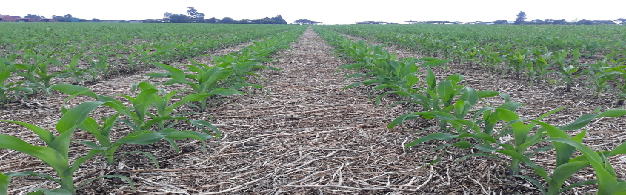
From learning to leading
After the intensive, trainees return home to establish demonstration plots and mentor neighbours, multiplying the reach of resilient techniques village by village.
Early Impact
Visible change in gardens, yields, and nutrition
Challenges
- Initial resistance from elders accustomed to chemical fertilisers.
- Rabies outbreaks in the second season reduced rabbit survival.
- Rainfed water-harvesting basins underperform during consecutive dry spells.
Lessons Learnt
- Women's seed-saving groups are the most reliable channel for diffusion.
- Combining training with an on-the-spot practice session doubles retention.
- Linkages with local agricultural extension offices sustain follow-through.
Monitoring & Evaluation
Data is collected at three levels so progress reflects both ecological and social change.
Looking Ahead
Building on the train-the-trainer model, the next phase will establish food-forest clusters at village scale. Once perennial yields stabilise, the project will layer in biodiversity enterprises — fish ponds, beehives, goats, and chickens — to diversify income while strengthening household immunity to the climate shocks forecast for the region.
Get Updates on This Work